
Norwalk's City Directory Shelf
The verified Norwalk directory set is small but meaningful. Catalog leads identify a 1953 volume, a 1960 volume, and a combined 1975-76 volume for Artesia, Cerritos, and Norwalk. The research does not verify an exhaustive first year, last year, or publisher run, so a gap should be recorded as a research limit rather than filled with a guess.
| Collection | Years | Where Held | Access |
|---|---|---|---|
| Norwalk, City Directory | 1953 | Norwalk Library Californiana | Closed-stack staff request; catalog lead |
| Norwalk, California, City Directory | 1960 | Norwalk Library Californiana | Closed-stack staff request; catalog lead |
| Artesia, Cerritos and Norwalk, California, City Directory | 1975-76 | Regional directory shelf | Ask for the combined locality volume |
| U.S. City and Business Directories | About 1749-1990 | FamilySearch collection | Catalog or account access may apply |
The table separates a Norwalk-specific title from a regional title. It also shows why an online catalog hit is not the same as a digitized page. The physical shelf, staff search, and catalog record may be the only route to an entry.
Norwalk Library's Closed Stacks
The Norwalk Library Californiana Collection is closed stack. It holds more than 24,000 books and more than 200 magazine and newspaper titles in paper or microfilm, along with census schedules from 1850-1910, nineteenth-century city directories, Alta California from 1849-1891, Los Angeles Star from 1851-1879, and official histories. Staff help matters because the catalog may place a useful title under a regional locality rather than the current city name.
Ask for Norwalk, Artesia, Cerritos, Downey, Bellflower, and Los Angeles County headings. A staff search can also reveal whether a volume is closed stack, on microfilm, or represented only by a catalog lead. The collection is especially valuable when a directory year sits between census dates or when a street label changed.
Closed stack means a reader requests the material through staff. It does not mean the collection is private. Ask for the exact title, year, locality, and whether a reader or staff search is available.
Three Norwalk Directory Editions
The 1953 and 1960 Norwalk titles give two direct snapshots. The 1975-76 combined Artesia, Cerritos, and Norwalk volume adds a regional view. That combined title is a useful quirk: the place name on the spine may not match the place name a modern searcher expects, yet the volume can still hold a Norwalk address or business.
Exact publishers and the complete reverse-directory run are not verified in the available research. A careful note should therefore say “catalog lead” when that is all the evidence supports. Photograph or transcribe the title page, edition, locality heading, page, and any abbreviation key before relying on an entry.
- Start with the 1953 title for a mid-century Norwalk surname or street clue.
- Check the 1960 title for a later address, occupation, spouse notation, or changed locality entry.
- Use 1975-76 when the search may cross the Artesia and Cerritos regional headings.
- Mark missing years and bridge them with the census, newspapers, deeds, permits, or probate.
The verified chronology is short, but it gives a clear set of checkpoints for a dated household search.
- 1953 - verified Norwalk directory catalog lead.
- 1960 - later Norwalk directory catalog lead.
- 1975-76 - combined Artesia, Cerritos, and Norwalk regional volume.
The oldest and newest year of the Norwalk collection should never be inferred from one catalog record. The library's staff can confirm what is actually on the shelf.
Regional Norwalk Directory Context
Norwalk's older resident history sits inside a wider Los Angeles County record landscape. The Californiana Collection includes statewide and regional material, and FamilySearch's U.S. City and Business Directories collection can expose catalog records beyond the local shelf. Search locality variants rather than assuming that every volume was issued under “Norwalk.”
Regional context can explain why a surname appears under Artesia, Cerritos, or Downey. It can also prevent a false gap when a family moved across a municipal line. The volume still needs a direct page check. A catalog description alone does not establish the fields present in an entry or the exact streets included.
The FamilySearch directory collection image below represents the online catalog route that complements the closed stacks.
Keep the regional title and the local place heading together in research notes. That small detail makes a later lookup reproducible.
Decoding a Norwalk City Directory Entry
A directory entry should be read as a dated listing, with each mark interpreted through the volume's own key. The available research did not expose an authoritative image of a Norwalk 1953 or 1960 page, so the field inventory below is a checklist for inspection rather than a claim that every edition contains every field.
| Name | Surname and given name or initial; note alternate spellings and the locality heading. |
|---|---|
| Household relation | Spouse, widow, or other marker when the volume supplies one. |
| Occupation or employer | Record the printed wording, but do not assume it identifies a home. |
| Address | House number and street, with any unit, direction, or boarder notation. |
| Reverse reference | Street-order or criss-cross entry when the volume includes one. |
- Criss-cross directory
- An address-order section that lets a reader move from street to listed name.
- Householder index
- A name-oriented list of a principal household or address entry.
- Abbreviation key
- The volume's legend for relationship, address, occupation, and listing marks.
- Locality heading
- The town or regional label under which the entry was printed.
Read the key before reading a symbol. A small mark can separate a residence listing from a business listing, or a head of household from an associated person. The entry is evidence for a date and place, not a present-day identity statement.
Norwalk's Downey Township Index
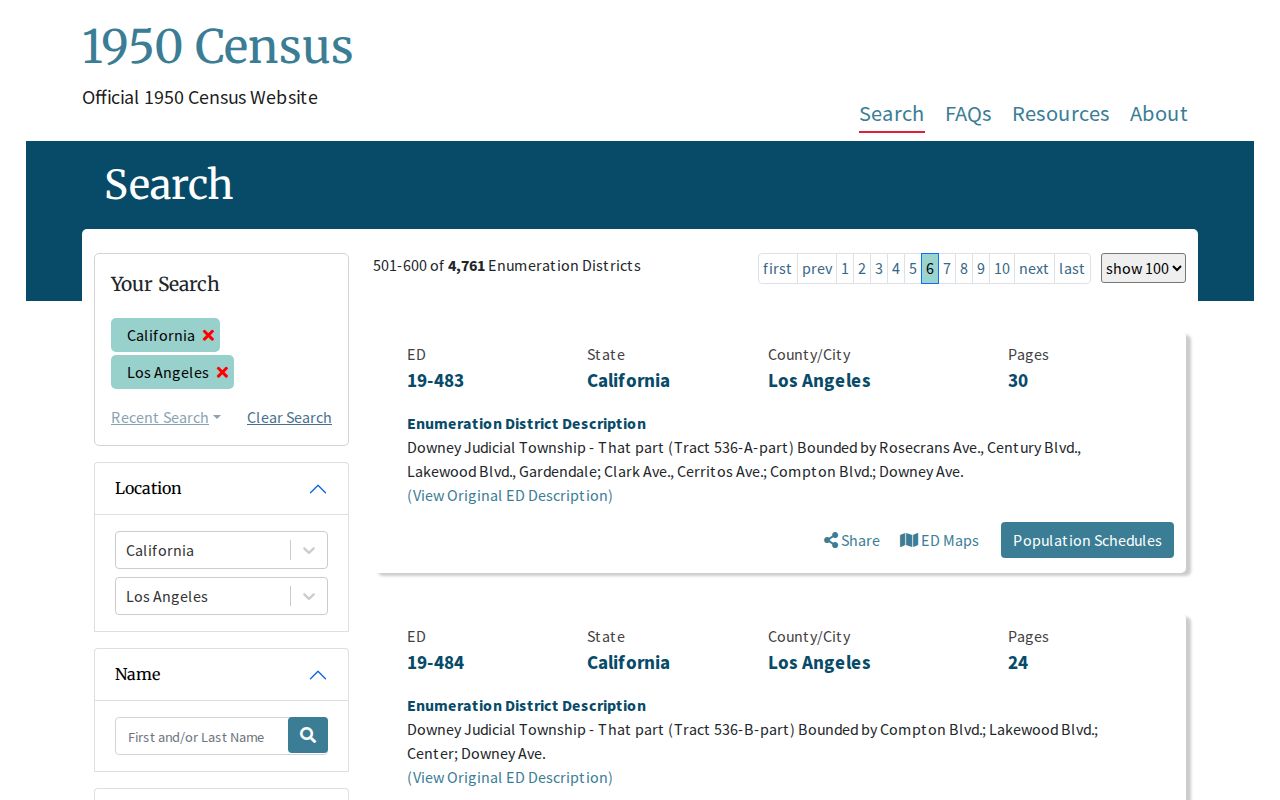
Before city incorporation, Norwalk-area residents may appear under Downey Judicial Township in census material. The 1950 census is indexed that way, and enumeration district 19-518 references Imperial Highway, Carmenita, Rosecrans, Bloomfield, Firestone, Norwalk Boulevard, Sproul, Clarkdale, Olive, and San Antonio. That geographic frame is a practical bridge between an older directory and a modern Norwalk search.
Search both the locality name and the township label. Then compare the street, household members, and nearby geography. A family can remain in the same area while the archive changes its jurisdiction heading. The local label is a catalog choice, not proof that the family moved out of Norwalk.
The 1950 census search provides the archive route. The newest public census is 1950 under the 72-year rule, so later household gaps need directories, deeds, newspapers, permits, or family records.
The 1950 census image below shows the township-index route used for a Norwalk directory search.
Norwalk Census and Directory Pairing
Pairing a city directory with a census snapshot is stronger than either source alone. A census gives an enumeration date and household composition. A directory can sit between census years and add an address, occupation, phone, spouse notation, or business clue. A deed adds a title relationship. A permit adds a work-history clue. Each layer has a different purpose.
- Record the directory title, year, locality, page, and address exactly as printed.
- Find the nearest public census year and search both Norwalk and Downey Judicial Township.
- Compare names, ages or relationships only as supporting clues, not as sole proof.
- Check the deed or parcel chain when the question concerns land rather than household presence.
- Use an obituary, probate record, newspaper, or later directory to explain a disappearance or move.
The method turns a directory gap into a bounded question. It also keeps a family-history search from treating every city directory entry as a complete list of everyone at an address.
Norwalk Directory Family History
Family-history work benefits from following a person and an address in parallel. Start with a known surname and a year. Note the first Norwalk entry, then search forward and backward for the same name, spouse, occupation, and street. If the name changes, retain the prior form in the note. Maiden, married, hyphenated, compound, and diacritic variants can affect an index result.
Use the city directory for a dated clue, then verify the clue in another record. A modern address result may connect to the Norwalk resident lookup workflow when a historical name needs a current record check, but an old directory should not be used to infer a current address. For an old parcel, the deed and legal description are usually more stable than the street string.
- Choose a person, household, street, and target year.
- Search the alphabetical name section and the regional locality headings.
- Write down address, spouse, occupation, phone, and any owner or widow mark the page actually shows.
- Flip to the reverse section, if present, and compare neighboring listings.
- Pair the result with census, deed, obituary, probate, or newspaper evidence.
A person disappearing from a city directory can mean a move, death, an unlisted household, a missing edition, or a changed locality heading. The next source should test those possibilities.
Norwalk's Missing-Year Bridges
The research does not locate an official Norwalk obituary index, complete telephone-directory run, exact reverse-directory series, or confirmed Sanborn edition. That is useful negative knowledge. It marks where a search must turn to the library staff, newspapers, probate, FamilySearch, the State Archives, or a custodian instead of implying that a missing year has no record.
Newspapers can place a family at a date, probate can explain an estate transfer, and a deed can tie a name to the same tract. FamilySearch California collections include county naturalizations from 1831-1985, birth index material from 1905-1995, death index material from 1905-1939 and 1940-1997, and probate estate files from 1833-1991. Those broad collections are not the same as a Norwalk directory, but they can bridge one.
The California State Archives image below marks one further archive route for a Norwalk directory gap.
Ask the library whether a particular title is in closed stacks, on microfilm, or only in a catalog. Ask for the locality heading used in the volume. That question is often more productive than asking for “all Norwalk directories.”
Questions for Norwalk Collections
A focused request gives the Californiana staff enough detail to search without guessing. State the surname, approximate year, street or locality, and whether the goal is a household, business, census, newspaper, or directory entry. Mention Artesia, Cerritos, Downey, Bellflower, and Los Angeles County as alternate headings when the local title is not found.
Request confirmation of the title page, edition year, publisher when printed, reverse section, abbreviation key, and page location. If a staff search cannot expose an exact year, preserve that result as a gap. A careful gap is better than an invented run and makes the next archive request more precise.