
Norwalk Resident Lookup Sources
Norwalk splits its records across systems built for very different jobs. A parcel record describes land. A deed records a transfer. A court index tracks a case. A vital record captures an event and its parties, while a license or business filing shows an affiliation. The coverage table below keeps those meanings apart so you read each record for what it actually says.
| Record | What It Can Confirm | Where | Access |
|---|---|---|---|
| Assessor parcel | AIN, situs, use, legal-description clue, assessed characteristics, and mailing address where shown | LA County Assessor Portal | Free address or AIN search; owner name not online |
| Recorded deed | Grantor, grantee, transfer date, document number, and legal description | LA County RR/CC | In-person name/year index; copy after identification |
| Court case | Party name, case number, type, filing events, hearings, and status | LA Superior Court | Case-type portals; some images and files restricted |
| Vital record | Birth, death, marriage, or divorce occurrence and parties | RR/CC, CDPH, or court | Authorized and informational paths differ |
| License or business filing | Professional status, entity role, agent, and reported address | DCA, SOS, or County Clerk | Free online search with record-specific limits |
A name match earns real weight only when a second record supplies something firmer: a middle initial, AIN, case number, entity number, license number, related party, or date. Remember that an owner is not always the occupant. A household member who holds no title may never appear in the property or deed trail at all.
Norwalk's Two-Record Method
Corroboration is the strongest habit in a Norwalk resident lookup. Pick one record that establishes a place or a legal relationship. Then chase a second source created for an entirely different reason. An AIN anchors land. A court case anchors a party. A license number separates two people who share a name. A birth or marriage record can document family ties. The requester must qualify for the copy.
This approach suits family reunions and estate work. It also helps with reconnecting to a former classmate, and with confirming an organization contact. It stops an old address from hardening into a present-day claim, too. Beside every result, write the source date. Note whether the record describes ownership, registration, a case, an event, or a business role.
- State the question in one sentence and list the fact already known.
- Choose the record type that directly answers that question.
- Use a second independent source with a different identifier or legal relationship.
- Resolve differences with the custodian that created the record.
- Stop when the source becomes restricted, confidential, or unrelated to the lawful purpose.
A resident lookup is a sequence of bounded checks, each answering one question. It is not a license to assemble everything findable about a person.
Norwalk Same-Name Controls
In a county this large, same-name errors happen constantly. Search surname variants, hyphenation, diacritics, initials, former names, and reversed name order. Under AB 64, in the 2025-26 change cycle, California began allowing specified diacritical marks on vital certificates, so an older index may flatten a mark that a newer certificate preserves.
Always use the identifier native to the source. An AIN and legal description govern land questions. A case number and party role govern court records. A corporation turns on its entity number, a professional on a license number. Age alone proves little. A business or agent address shows an affiliation, not a home.
- Docket
- The court's running list of filed events, hearings, and status entries.
- Index
- A finding aid that points to a record; it may not include the full image.
- Certified copy
- A custodian-issued copy with formal status, distinct from an informational copy or screen result.
- Disposition
- The recorded outcome or status of a case or proceeding when the source supplies it.
Record every positive match and every reason you rejected a namesake. Those notes make later family-history work clearer and help a clerk understand a correction request.
Verifying a Norwalk Resident
Start with a place or an event, and end with two agreeing identifiers. Known address? Use the Assessor Portal for the AIN and parcel facts. Known name plus a case clue? Use the appropriate Los Angeles Superior Court service. Known birth, death, or marriage event? Identify the correct county or state custodian first, then order the copy.
- Anchor the person to a known address, parcel, business, case, family event, or year.
- Search the first official index using exact name and the source's own identifiers.
- Compare the result with a second record, such as a deed, court summary, license, directory, or vital index.
- Order a certified copy only when eligibility and the purpose require formal proof.
- Ask the custodian to correct a wrong entry rather than relying on a third-party compilation.
Index versus image matters here. A result line only shows that a record exists. The image or certified copy carries the details a family or estate question actually needs.
Norwalk Court Case Access
Los Angeles Superior Court runs separate access paths for civil, criminal, family, probate, traffic, and small-claims matters. Norwalk Courthouse sits at 12720 Norwalk Boulevard. Case Access can display a number, courthouse, filing date, case type or title, parties and roles, officer, status, hearings, and register entries. The right next step is a case-number search, not a wider name search.
The court's field inventory includes a required case-number entry for Case Access, a case-number entry for calendar information, a linked party or defendant-name search, a Case Document Images service, and a filing-court locator by city or ZIP. Name searches carry a cost. Civil images may arrive through a guest or account service with a fee. Criminal and family images generally do not travel the same remote path.
| Case Access | Enter a case number to open a civil, criminal, family, probate, or small-claims summary. |
|---|---|
| Calendar | Enter a case number to view future hearing information when available. |
| Party or defendant search | Name-linked mode for civil parties or criminal defendants; fee applies. |
| Document images | Guest or account service for limited civil, unlimited civil, or small claims; no general criminal or family image route. |
| Filing court locator | City or ZIP field used to identify the courthouse. |
| Case number | Precise identifier for the filing and courthouse. |
|---|---|
| Parties and roles | Names and the legal role assigned in the case summary. |
| Filed date and type | Time and category used to separate similar names. |
| Hearings and register | Future hearings and filed-event entries when remotely available. |
| Disposition or status | Outcome or current case status if the public summary supplies it. |
The California Courts case-access guidance page lays out the local, case-type-specific path used in a Norwalk resident lookup.
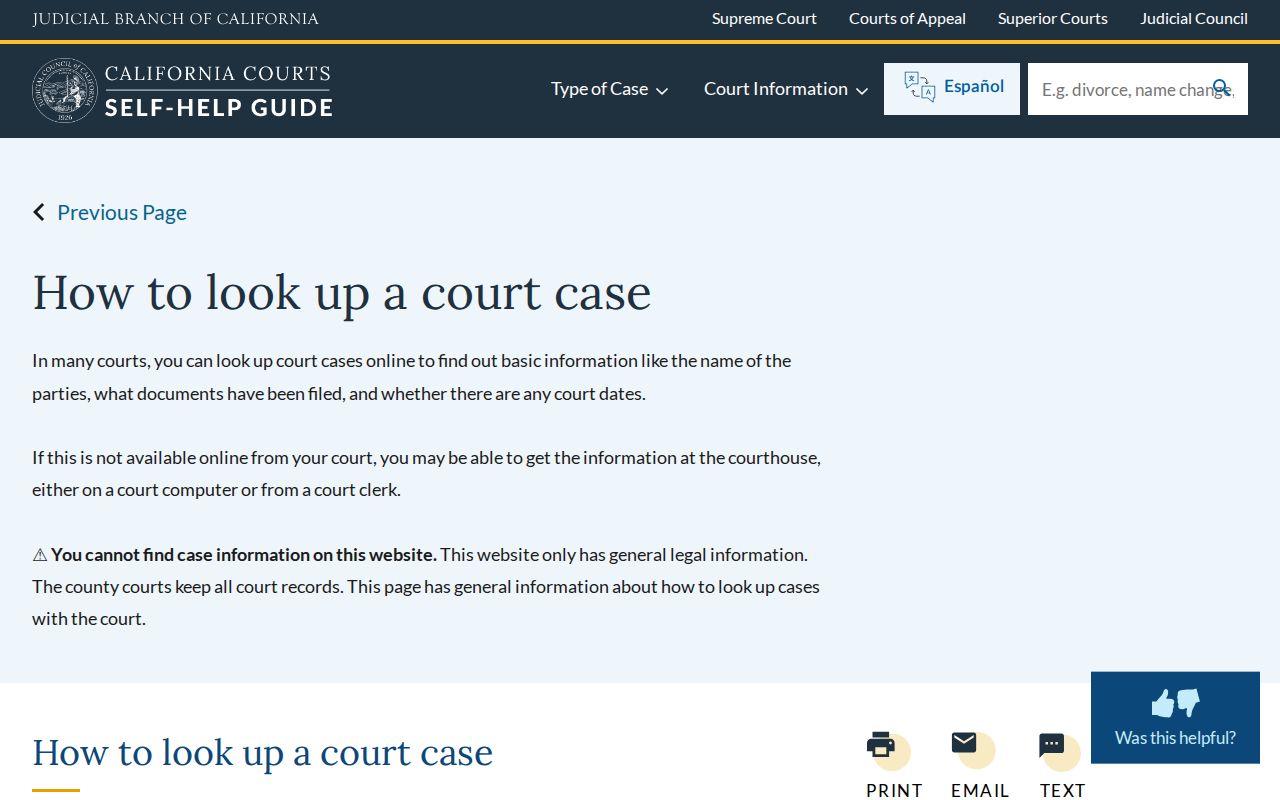
Juvenile, adoption, guardianship, mental-health, harassment, protective-order, sealed, and other restricted records all demand the proper courthouse or clerk route. PACER handles federal cases separately, with an account and per-page charges.
Norwalk Vital Record Copies
Vital records prove an event and a family tie, though who may order a copy varies by record type. The RR/CC keeps county birth, death, and public-marriage copies. CDPH holds statewide records from July 1905. Confidential marriage copies sit with the County Clerk and go only to a party or by court order under Family Code section 509. Divorce decrees stay with the courts; a state certificate of record is not the decree itself.
California gives requesters two paths: authorized and informational certified copies. Authorized birth and death copies demand statutory eligibility under Health and Safety Code sections 103526 and 103526.5, and the CDPH VS 111 request pairs a sworn statement with notarization for that copy type. Informational copies reach a wider group but bear an identity warning. The 2026 state schedule lists $31 for birth, $26 for death, $19 for marriage, and $18 for dissolution.
County modern records may arrive same day. Older or exception years can be mailed within 20 business days. Random searching is barred. A Norwalk resident lookup goes smoothly when the request names the event, county, date range, relationship, and copy type before anything is sent.
Norwalk Voter Lookup Limits
LA County's Registration Status service is an identity-authenticated self-lookup. A voter can confirm their own registration through it. It is not a public people finder. It offers no anonymous street browse. Broader voter material rests with Election Information in Room 2013, governed by Elections Code sections 2187 and 2194.
The certified voter-copy form asks for full name, date of birth, residence address, city and ZIP, any different mailing address, telephone, signature, and payment. An own copy costs $1.50. An authorized other copy runs $6.75. A search is $5 per name, and history is $6.75 per name. A file order must state applicant identity, qualification, permitted purpose, jurisdiction, record type, agreements, and signature. The countywide file costs $146, while city, district, or precinct options carry separate fees.
The LA County voter information request page shows the split between a personal status check and a public Norwalk resident lookup.
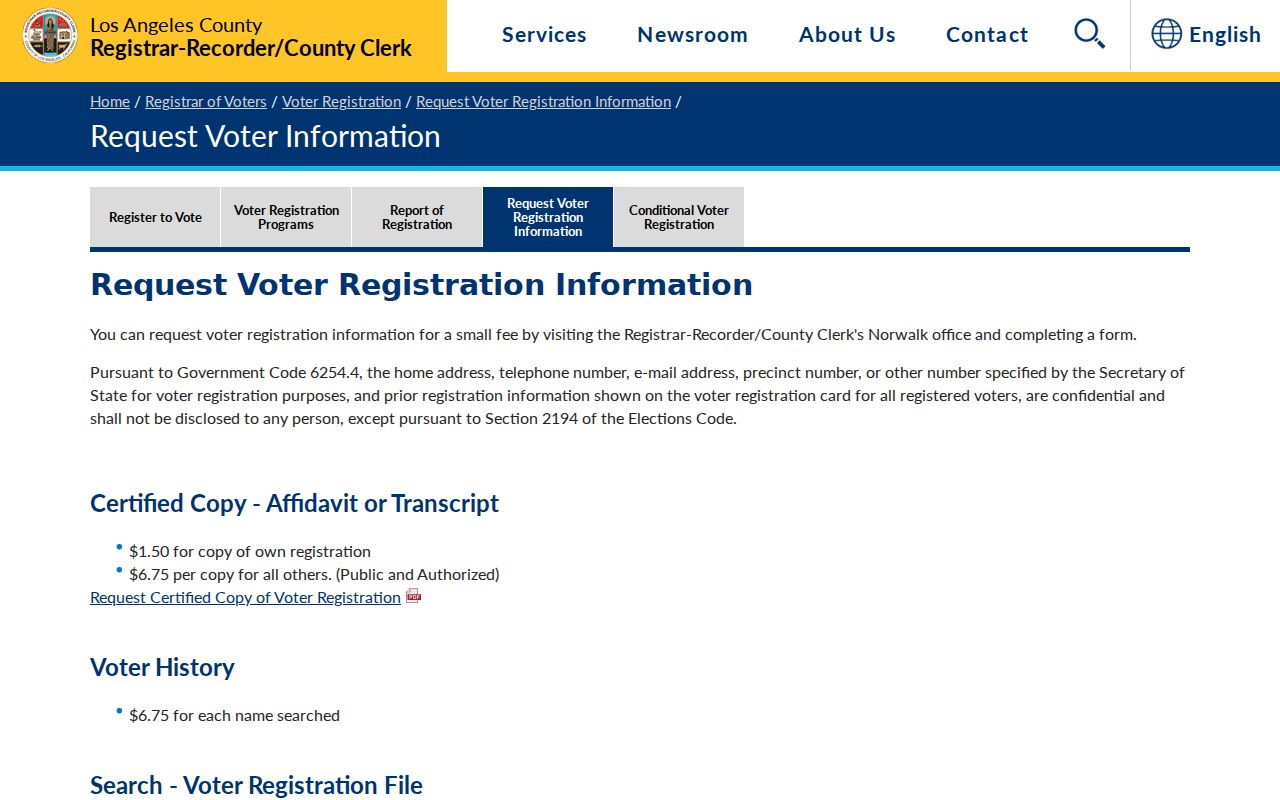
Note: Participation history can show election participation, but it never shows a person's ballot choice and does not create a complete list of a Norwalk address.
Norwalk Business and License Trails
Business and professional records can settle a name. The question might involve a public role, a civic group, or an entity. California DCA searches by board, license type, number, business, or first and last name. Advanced filters narrow by city, county, status, discipline, and public documents. The California Secretary of State's bizfile searches an entity name or file number. It can show status, jurisdiction, agents, addresses, filing history, and available PDFs.
Los Angeles County fictitious-business-name filings add a county clerk source. The State Controller's unclaimed-property search can yield an older city or reported-address clue. That clue may be stale, and a claim needs proof. Remember the limit. A business address, agent address, license contact, or unclaimed-property locality is not proof of a home. So read the legal relationship printed in the record.
The California State Bar license search shows a board-specific professional lookup. It can separate names without becoming a residence claim.
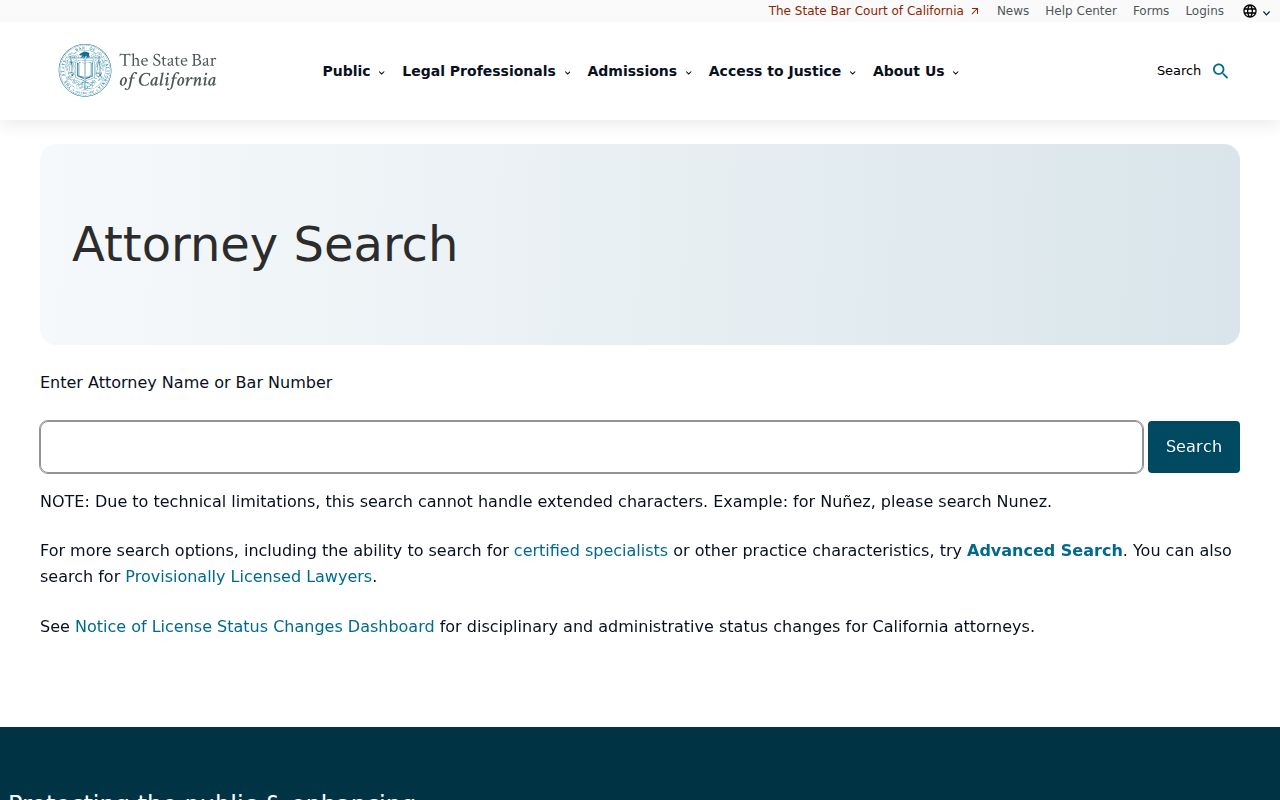
- Use an entity number to separate similarly named organizations.
- Use a license number and board to separate professionals with similar names.
- Use a filing date to place an address clue in time.
- Ask the originating custodian to correct a wrong business or license entry.
Norwalk's Safe at Home Shield
Safe at Home is a California confidentiality program for eligible participants. It provides a substitute mailing address, confidential voter registration, and protections for specified records. Enrollment is free and renewable on a four-year cycle through an authorized agency. The program does not erase old records. It can change what a public search displays.
A missing street address, a substitute address, or a withheld voter record should be read as an intentional privacy control. The same caution covers sealed court material, confidential marriage records, and protected birth records. It also covers other legally limited sources. A Norwalk resident lookup stops at the lawful boundary. It does not try to defeat a confidentiality program.
Norwalk's Lookup Privacy Rules
California's CCPA and CPRA, Civil Code section 1798.100 and following, give covered consumers rights to know, delete, correct, opt out of sale or sharing, limit sensitive information, and avoid discrimination in covered commercial data use. Public government information generally sits outside that framework. A broker privacy request can fix a compilation. Only the government custodian can correct the source record.
The state's DROP program opened in 2026 and sends one deletion request to more than 500 registered brokers, with processing duties starting August 1, 2026. Global Privacy Control and a custodian correction request can complement that route. Keep your confirmation numbers and dates. An opt-out is not a tool for removing an official deed, court file, or vital record.
Lawful personal use. Use a Norwalk resident lookup for family history, estate work, reconnecting, personal safety, or civic research. Do not use a record to stalk, harass, intimidate, or make repeated unwanted contact. Public access does not cancel California's privacy and harassment laws.
When a record is wrong, go to the source. Contact the Assessor for parcel data, RR/CC for recorder or vital indexing, the court clerk for a case record, or the licensing board for a license entry. A CPRA request can seek an identifiable nonexempt city or county record, but it cannot force an agency to build a new list or disclose exempt personal information.