
Norwalk Neighbors Around One Address
A block lookup has three layers. First, locate the starting parcel. Second, record the adjoining AINs and situs addresses from the map. Third, decide which lawful record channel answers the question about each parcel. The map can show geometry. The Assessor's offline roll can supply an owner name. The recorder can show title parties after a name-and-year search. None of those channels supplies a complete list of people living on a block.
| Source | What It Shows About a Block | Access |
|---|---|---|
| Assessor map and parcel detail | Adjoining shapes, AINs, situs, use, units, structures, values, and map links | Free address, AIN, or map search; owner name not on public web |
| Assessment ownership roll | Owner and tax-mailing address for the parcel when obtained through the lawful county channel | In person or Property Data Sales |
| RR/CC deed index | Grantors, grantees, transfers, liens, and legal descriptions | In-person name/year index; copies after identification |
| Voter information | Registration or election geography under a permitted purpose | Self-lookup, mail, in person, or restricted file order |
| Community directory | Organizations, civic contacts, and public-facing member or category leads | Norwalk Chamber and organization-specific channels |
Neighbors can mean adjacent parcels, nearby civic groups, or people connected by a shared block. Say which meaning is intended before searching.
Norwalk Neighbors and Parcel Geometry
The Assessor Portal map is the best starting point for nearby parcels. Enter the known address, open the map, pan across the block, and click each bordering shape. Record the AIN and situs for every parcel. The map view is useful because it shows geometry before names. LA County GIS-NET Public documents identify, layer, buffer, measure, report, and export tools, but the research says it is primarily aimed at unincorporated territory. Incorporated Norwalk parcels should be checked in the Assessor map.
There is no verified public radius export for Norwalk neighbors. A hand-built AIN list is therefore more transparent than an assumed “nearby people” result. The county zoning map supplies planning context, not a block roster. Keep a note of the date and map source so a later check can distinguish changed parcel data from a changed household.
The Census QuickFacts page image below adds a scale-and-place reminder for neighborhood research without turning a population statistic into a list of individuals.
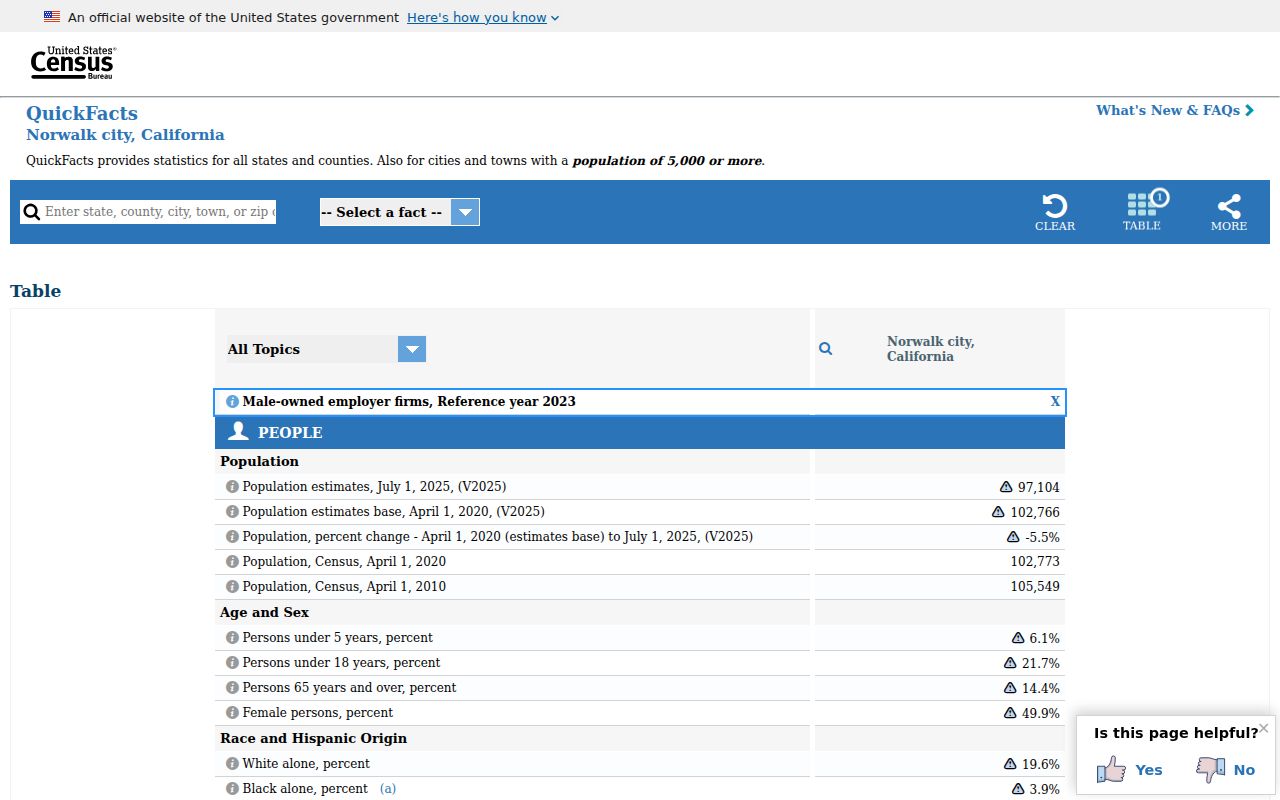
Census QuickFacts reports 102,773 residents in 2020 and an estimated 97,104 in July 2025. The figure gives city context, not a parcel-level neighbor result.
Norwalk Neighbor Parcel Records
A clean block list is a small research record. Start with the known address, save its AIN, then add only the parcels that share a boundary or sit directly across the street when that is the stated scope. Record the situs, use, unit count, and map link. Do not add a person's name until the parcel question is clear.
- Enter the known Norwalk address or AIN in the Assessor Portal.
- Pan and click the adjoining parcel shapes; note each AIN and situs.
- Check whether a parcel is a multi-unit structure, an institution, or another use.
- Use the owner-name channel only when a lawful title or parcel question requires it.
- Keep the parcel list separate from a community contact list and from private household assumptions.
The list is a process control. It keeps Norwalk neighbors tied to actual map geometry and prevents a similar street number from entering the wrong block.
Mapping Norwalk's Block Parcels
After the AIN list is built, move through the records in a fixed order: address to parcel, parcel to owner channel, owner name to RR/CC name-and-year index, and deed to legal description. For adjacent parcels, repeat the path only when the question concerns title or transfer. For a community question, stop at the public organization or neighborhood resource rather than seeking private household details.
The flow is address → AIN → adjoining geometry → lawful owner channel → deed index → dated community source. Each arrow changes the kind of evidence. The AIN identifies land. The deed identifies recorded parties. A directory or civic group identifies a public-facing association. No arrow creates a general resident list.
Mailing equals situs only by coincidence. A tax-mailing address may be outside the block. A unit count may show that one parcel has several dwellings, but it does not name occupants. A Norwalk neighbor lookup should say “adjacent parcels” when that is what the map actually establishes.
Norwalk Unit and Parcel Clues
Parcel detail can show use, parcel type, tax area, exemptions, structures, units, beds, baths, square footage, build year, effective year, values, and map links. Those fields help distinguish a single-lot home, a multi-unit parcel, an institutional use, or a commercial corridor. They do not reveal every person connected to the place.
Year Built means at least half of original construction was complete. Effective Year Built reflects major rehabilitation. Assessment boundary descriptions are not deed legal descriptions, and aerial overlays may not align with a survey. Use the deed or a licensed surveyor for a legal boundary question. Use a record custodian for a person question.
- Adjacent parcel
- A mapped parcel that shares a boundary or lies directly beside the starting parcel.
- Unit count
- A parcel characteristic that describes structures or units in the assessment record, not named occupants.
- Buffer
- A map-area operation that draws a radius or shape; no verified public Norwalk resident export was found.
- Situs
- The physical parcel location, distinct from a tax-mailing address.
Norwalk Voter Street Limits
California voter data is not an unrestricted street household roll. The LA County status tool is for a voter checking their own registration. Broader data is handled by Election Information and is limited by Elections Code sections 2187 and 2194. A voter-file order requires a stated qualifying purpose, and an unauthorized use can carry penalties under Elections Code section 18109.
A certified copy request asks for full name, date of birth, residence address, city and ZIP, mailing address when different, telephone, signature, and payment. An own copy costs $1.50, an authorized other copy costs $6.75, and a file search costs $5 per name. A countywide voter file is $146, with smaller city, district, or precinct products priced separately. No anonymous block browse exists.
Note: Voter participation history can show election participation, but it never shows ballot choice and should not be treated as a public list of Norwalk neighbors.
Norwalk Neighbors and Community Leads
The Norwalk Chamber member directory is a public-facing community lead. It searches by term and business category, and results may show an organization, address, phone, email, web address, fax, or contact. The research identifies American Legion Post 359, Elks 2142, Lions, 605 Kiwanis, Cerritos College, and the Norwalk-La Mirada Unified School District among the directory's recognizable entries.
These organizations can point a family-history or civic researcher toward anniversary books, newsletters, alumni material, or public events. Private rosters are not presumed public. Cerritos College at 11110 Alondra Boulevard may hold alumni, yearbook, or campus-paper material, but the research did not locate a finding aid.
| Community Resource | Possible Neighbor Context | Access Caution |
|---|---|---|
| Norwalk Chamber directory | Organization, category, public contact and business information | Search public listings; do not infer a private home |
| American Legion Post 359 | Veteran and civic history lead | Ask about public anniversary material |
| Elks 2142, Lions, and 605 Kiwanis | Community organization and event history | Private member rosters are not assumed open |
| Cerritos College | Alumni, yearbook, and campus-paper lead | No verified finding aid located |
| NLMUSD | School and district community context | Use official records and archive channels |
The Norwalk Chamber member directory image below shows the kind of public community source that can add context around a block without exposing a private roster.
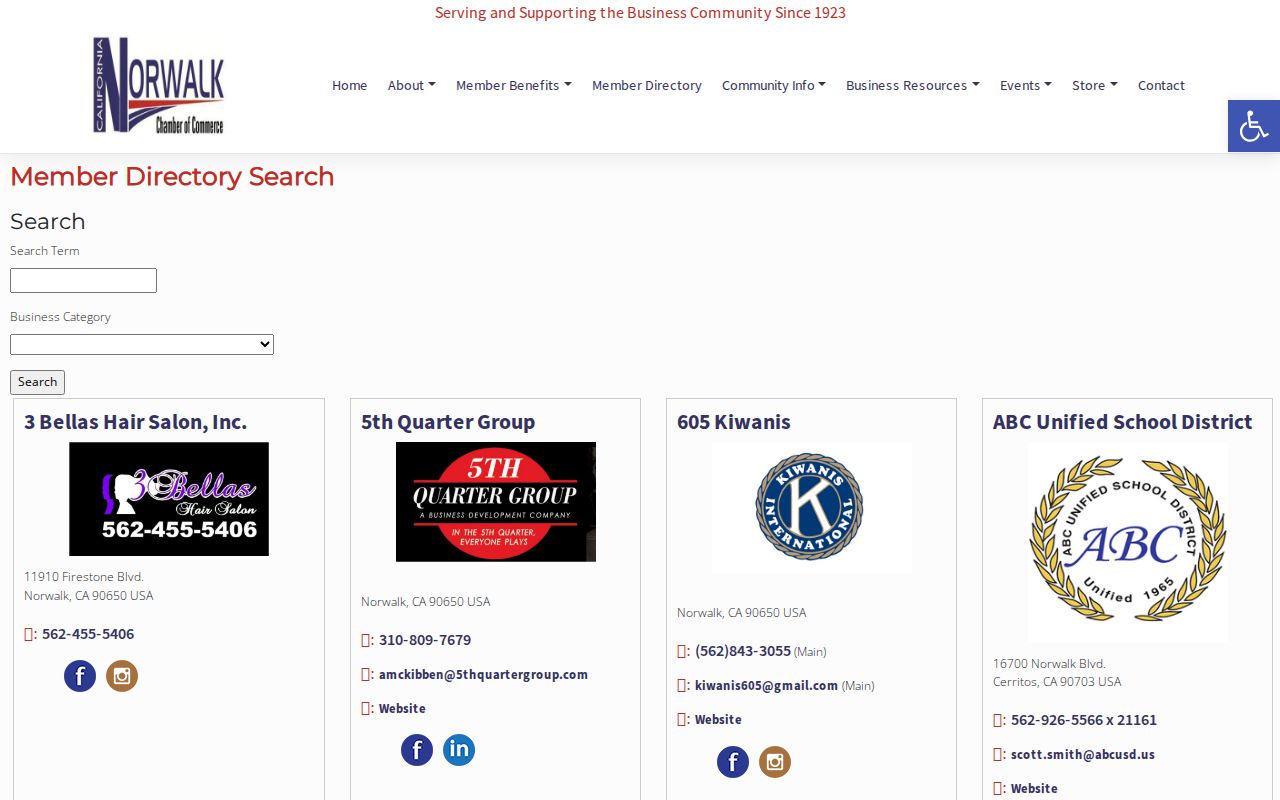
Ask a group for public history, not for a private address list.
Norwalk Chamber and Cerritos Connections
Norwalk's civic geography does not stop at a parcel line. The Chamber directory links organizations, Cerritos College, and NLMUSD in a public community layer. Alondra Library adds a Mexican-American heritage emphasis. The NPS Johnston-Hargitt nomination cites a 1970 Charles Hargitt oral history and the Gilbert Sproul Museum. These resources can help explain who shaped a neighborhood or where a family memory may be held.
Use the community layer for interviews, anniversary books, newsletters, school papers, and local-history leads. Do not treat an organization's membership or contact file as a public residents directory. A shared event, campus, or civic affiliation is not evidence that two people live next to one another today.
When a block question shifts to a full named street, the Norwalk street directory path handles the address chain. The neighbors workflow stays centered on the immediate block and public community context.
Norwalk Neighbor Privacy Rules
A map can show adjacent land while a person remains outside the public record. DMV data is restricted. Utility customers, delivery data, minors, non-owner household members, and protected voter records are not a general block list. Safe at Home can replace a participant's address with a substitute mailing address and confidential voter treatment.
| Official Source | Private or Commercial Category | Practical Difference |
|---|---|---|
| Assessor parcel and map | Merged address and marketing data | Official parcel key and fields are clearer; commercial data may lag |
| RR/CC deed index | Compiled title or contact claims | County index uses name and year; it is not an online address list |
| Voter self-lookup or approved file | Unrestricted neighbor lists | California purpose rules and confidentiality protections apply |
| Chamber or civic directory | Private roster compilation | Public-facing contacts do not imply a private membership list |
Lawful use. Use a Norwalk neighbor lookup for block history, civic research, family connections, estate work, or personal safety. Do not stalk, harass, intimidate, or repeatedly contact anyone because a map or record supplied a clue.
Public access is not permission to assemble a private dossier. Verify the narrow fact needed and stop when the record becomes confidential or the purpose no longer fits lawful personal research.
Norwalk's Safe at Home Boundary
Safe at Home is a free California program with four-year renewable enrollment through an agency. It can provide a substitute address, confidential voter registration, and protections for specified records. It does not erase old records. A blank, withheld, or substitute address is therefore a privacy signal, not proof that a neighbor is absent from Norwalk.
The California Secretary of State Safe at Home privacy guidance image below explains why a block search may stop at a protected boundary.
Respect the custodian's access rules and use the official California channel for any eligibility or correction question.